Research
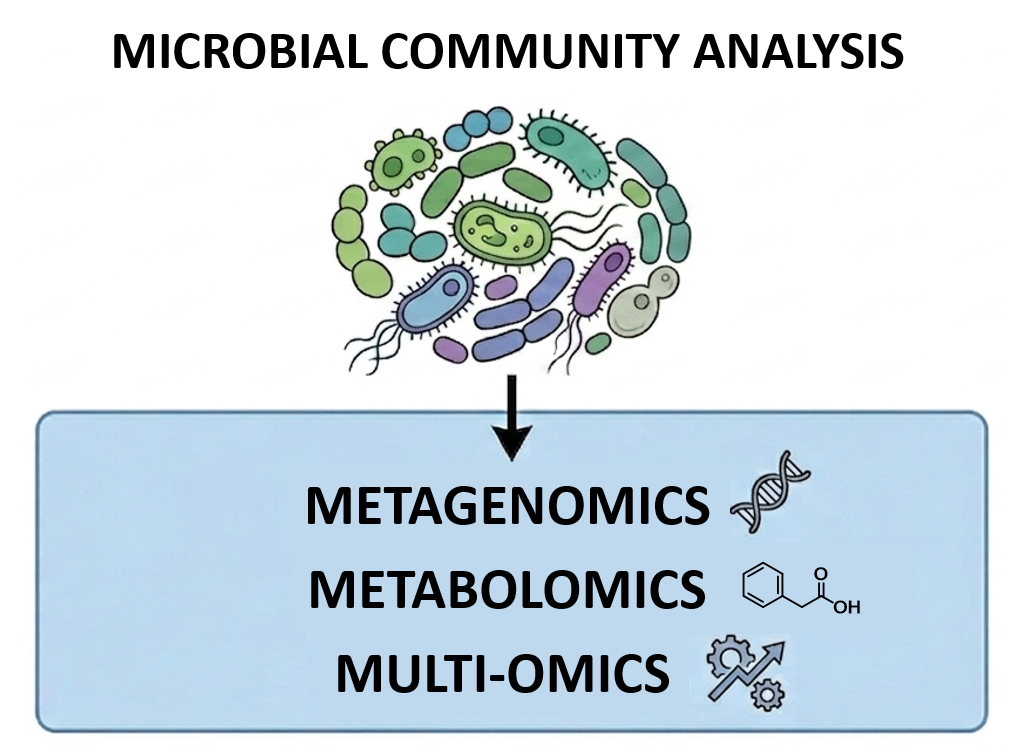
Study of microbial communities subjected to perturbations using omics approaches
In order to exist, microbial communities live in an ecological equilibrium. However, this equilibrium can be distorted by an environmental disturbance (e.g., nutrient limitation, exposure to chemical hazards).
In my research, I study the biological responses of microorganisms in these communities to these exposures with the aim to:
- understand microbial mechanisms to cope with perturbations.
- discover whether the perturbations trigger some metabolic process in one or more microbial species that interferes with the growth of other species or leads to a modification of ecosystem characteristics. An example of the latter is when changes in our dietary pattern alter the intestinal microbiota, which ends up affecting our state of health.
- identify how microbial communities are modified in order to be able to identify new strategies to counteract the effect of perturbations and thus return the microbial communities to the ecological balance that existed before the perturbation.
Over the years, I have worked primarily with two types of microbial communities.
In the last years, I have been investigating the human gut microbiome, which comprises the microbial species that live in the intestinal tract in humans. Some of these microbial species are beneficial, while others are pathogenic. Over the past two decades, some evidence has emerged linking the gut microbiome to the pathogenesis of several common metabolic disorders, such as obesity, type 2 diabetes, non-alcoholic liver disease, cardiometabolic diseases and malnutrition. However, the precise mechanism of how the gut microbiome is able to cause pathogenesis remains unclear. Along these lines, I employ liquid chromatography coupled to mass spectrometry (HPLC-MS)-based metabolomics, combined with a non-targeted data analysis strategies, to comprehensively characterize the circulating human metabolome (the set of metabolites found in the blood) with the aim of detecting metabolites that are of microbial origin and, among them, those that could cause such pathogenesis.
Beyond the gut microbiome, I have also studied the microbial community that carries out anaerobic digestion of waste, such as those that can be found in anaerobic reactors from waste management plants. Anaerobic digestion can be regarded as a multistage process in which an organic substrate (such as organic waste) is converted into biogas by microbial action. Each of the stages included in this process is carried out by a specific group of microorganisms, and a change in the ecological fitness in the reactor where the process takes place due to a disturbance can lead to premature termination of the process.
Various factors can disrupt the anaerobic digestion process, most notably the accumulation of ammonia and short-chain fatty acids within the reactor. Traditionally, these disruptions have been studied either through a technical lens (e.g., focusing on parameters like pH and temperature) or through gene-sequencing methods such as 16S rRNA and metagenomics. However, the application of other ‘omics’ technologies remains rare. Given that anaerobic digestion is, at its core, a metabolic process, my research have employed metabolomics to identify how specific perturbations alter the degradation of wastewater sludge. To achieve a more comprehensive understanding of these metabolic shifts, I have integrated this approach with established sequencing-based methods to provide a multi-omic perspective on the system.
Development of computational tools
Chemometrics is the chemical discipline that uses mathematical, statistical and other methods that employ formal logic to design or select optimal measurement procedures and experiments, and to provide the maximum relevant chemical information by analyzing chemical data.
Chemometrics can be used for many purposes, including sample selection, signal processing, sample clustering, prediction of results…. In short, chemometrics can be used to transform chemical data with the aim to extract or generate knowledge, and most applications can be found in analytical chemistry, environmental and biomedical fields.
Over the years, I have developed several chemometric methods and designed several computational workflows to improve the interpretation of omics data.
Among the methods I have developed, I can highlight:
- The DTC-MCR-ALS chemometric method, which allows to extract with little user supervision resonance integrals from 1H NMR spectra data and to cluster resonances of the same compound. The core of this method is based on the MCR-ALS method, which performs a bilinear decomposition of the data in a reduced subspace while keeping most of the original information. One of the many advantages of MCR-ALS, compared to other bilinear decomposition methods such as the PCA method, is that the resolution to the optimal solution is guided by constraints defined by the nature of the chemical data, such as non-negativity or spectral selectivity. Matlab scripts can be downloaded from the project’s GitHub page.
- The VOI chemometric method for removing noise in multidimensional NMR data. This method was initially designed to remove noise from datasets of 2D NMR spectra of metabolomics samples, where peak selection and discerning between small resonances and peaks or noise can be tedious. Matlab and R scripts can be downloaded from the project’s GitHub page. In addition, this method has been included in the commercial program MNova.
- The R.ComDim package, which contains the functions to be able to use the ComDim method. ComDim is a chemometric method for analyzing multi-sets. The solution obtained with ComDim maximizes the common variance among all the sets. In addition, one of the advantages of using ComDim lies in the fact that the matrices resulting from this decomposition are not only informative for each set, but also reveal how the different sets are related to each other. The ComDim method was initially coded in Matlab by the Chimiométrie group. In the R.ComDim package, additional functions were added to facilitate the construction of multiple sets and to generate graphs to aid in the interpretation of the data from a multi-omics perspective. The R.ComDim package can be downloaded from the project’s GitHub page.
More recently, I have focused on developing computational workflows for high-throughput HPLC-MS analysis, enabling the processing of large-scale cohorts (>1,000 samples) and intensive metabolite annotation (>600 compounds). This involved implementing traditional data-processing strategies from the mass spectrometry metabolomics, such as batch correction, annotation of metabolomics features, assessment of the confidence in these annotations. Furthermore, I have designed strategies for building comprehensive spectral libraries, for annotating the ‘dark metabolome’ using artificial intelligence, for generating reports from the metabolomics data, and for automating laboratory quality control (e.g., assessment of chromatographic column performance and instrument sensitivity). These methodologies are currently being used at the IMPACT-PM metabolomics platform in Lille (France), where I am the lead in chemometrics and chemoinformatic workflows.
For more details about my research, check my publications.